









Southern Exposure
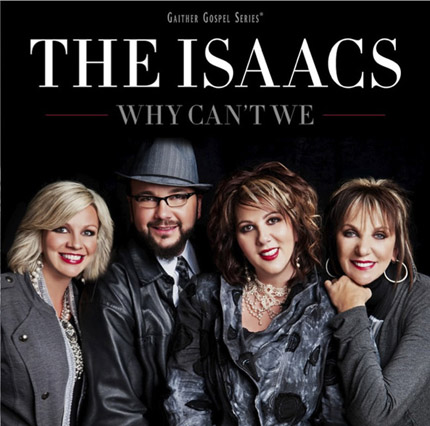
The Isaacs' Why Can't We
A Review
A Review

The Isaacs/Why Can't We
Gaither Music
Produced by Ben Isaacs
Why Can't We, The Isaacs' latest project, is undoubtedly one of the most moving and compelling gospel releases of 2011. With this album, Sonya Isaacs Yeary, Rebecca Isaacs Bowman, Lily Isaacs and Ben Isaacs are bound to exceed every fan's expectations with their exemplary family harmonies, masterful instrumentation and exceptional depth of songwriting.
Gaither Music
Produced by Ben Isaacs
Why Can't We, The Isaacs' latest project, is undoubtedly one of the most moving and compelling gospel releases of 2011. With this album, Sonya Isaacs Yeary, Rebecca Isaacs Bowman, Lily Isaacs and Ben Isaacs are bound to exceed every fan's expectations with their exemplary family harmonies, masterful instrumentation and exceptional depth of songwriting.
Foot-tapping numbers like Randall Hylton's "Hallelujah Turnpike," a bluegrass gospel song made popular by the likes of the legendary Lewis Family, are fun to listen to. And catchy songs like "Four Men Walking Around" and "Get On Board" offer a fresh take on familiar biblical stories. But other songs particularly stand out because of their contemporary themes and inspirational messages.
Ben, who wears the coolest hats, both literally and figuratively (as a producer, vocalist, writer and master of the doghouse bass!), and Rebecca capably set the mood on the title track as Sonya's soaring lead propels the bridge and final choruses straight to the heart. This song is sure to prompt contemplation and self-examination as it reflects on how we often find it difficult to forgive ourselves or others when God has already put a matter to rest.
Ben, who wears the coolest hats, both literally and figuratively (as a producer, vocalist, writer and master of the doghouse bass!), and Rebecca capably set the mood on the title track as Sonya's soaring lead propels the bridge and final choruses straight to the heart. This song is sure to prompt contemplation and self-examination as it reflects on how we often find it difficult to forgive ourselves or others when God has already put a matter to rest.
Those Wonderful Ads!
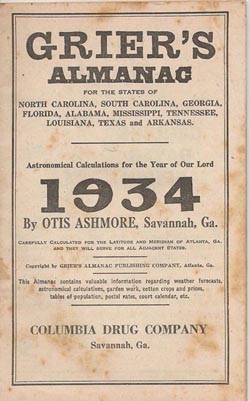
Older issues of Grier's Almanac are desired by collectors because of the advertising. Within the pages of the 1934 issue (pictured below right), one can find ads for Bayer aspirin, Cheney's Expectorant (for coughs) and Feen-a-mint ("The Laxative That's Just Like Chewing Gum"). While these products were quite common and widely used at the time, a few other items were offered by more obscure companies, and following are just a few of the standouts:
Lots of Useful Stuff, Too
Besides a few hilarious ads and plenty of legitimate promotions, Grier's Almanac contains a helpful gardening calendar, zodiac information, a religious section, a chronological listing of memorable events and informing general interest articles.
Older issues of Grier's Almanac are desired by collectors because of the advertising. Within the pages of the 1934 issue (pictured below right), one can find ads for Bayer aspirin, Cheney's Expectorant (for coughs) and Feen-a-mint ("The Laxative That's Just Like Chewing Gum"). While these products were quite common and widely used at the time, a few other items were offered by more obscure companies, and following are just a few of the standouts:
- 6 6 6 a remedy for colds, headache, fever, biliousness, malaria and constipation available in liquid, tablets, nose drops and a salve! (Editor's note: I'd have to be pretty miserable before I would take something called "666.")
- Smith's Worm Oil, a product of the Galenol Company, Inc. of Atlanta. Described as "one of the oldest and most reliable worm medicines sold."
- Lydia E. Pinkham's Vegetable Compound, a "tonic and regulator" for "girls in their teens." The ad states, "Teach her how to guard her health at this critical time . . . When she is a happy, healthy wife and mother she will thank you."
- Securitee, a "renowned prescription in a jellied form" described as the "married woman's sure, safe method." "Are you financially able to take care of babies and give them the proper attention?," the ad asks. "If not it may be best to delay." Haven't times changed? Today, there is considerable debate over whether school kids should learn about contraception and the prevention of sexually transmitted diseases at younger and younger ages. In 1934, amid the Depression, an ad offering some form of pregnancy prevention made no mention of the word sex, of course, but its intent was pretty clear. "Every married couple should have babies, but it is a great injustice to bring the little darlings into the world if all conditions are not just right." Interesting to note, 1934 was probably not one of those years in which conditions were "just right" for raising children for most southern couples.
- Lucky Las Vegas Cologne (Editor's note: If you're willing to throw away your money at the casinos, spending $5.55 on this stuff probably can't hurt!)
- Dragon's Blood Uncrossing Bubble Bath, "used to destroy jinxes" (Editor's note: A normal shower with soap and water suits me just fine. Jinxes don't scare me.)
- "Make Opposing Lawyer Stupid" Oil and Candle (Editor's note: This must have been used by the O. J. Simpson defense team. Oops, I shouldn't have said that!!!)
- "Stop Evil" Spray Cleaner "Chase evil out of home, church, business," says the ad. (Editor's note: Obeying the Bible and saying, "Get thee behind me, Satan," has always worked for me!)
Lots of Useful Stuff, Too
Besides a few hilarious ads and plenty of legitimate promotions, Grier's Almanac contains a helpful gardening calendar, zodiac information, a religious section, a chronological listing of memorable events and informing general interest articles.
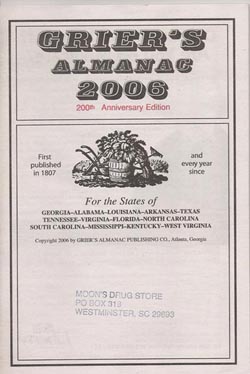
Copies of Grier's Almanac are distributed via drug stores, feed & seed dealers and direct mail.
"God Still Has a Plan," beautifully performed by the group's matriarch, Lily, reminds those who "think their best days are through" that God's plan for them did not expire when they perhaps became empty nesters, lost a spouse or began collecting pension checks. Writers Rebecca, Sonya and Sonya's husband, singer-songwriter Jimmy Yeary, are to be commended for reaching out to those believers who dismiss their usefulness amid the work of younger Christians or doubt the significance of the wisdom they have to offer.
Poignant and evocative, "Why" acknowledges that we cannot wrap our minds around human suffering, but the succeeding song, the late James McFall's "I Still Trust You," serves as a positive declaration of faith in the One who is ultimately in control and sees the bigger picture.
And "I'm Gonna Love You Through It," a powerful song born in part out of Lily's breast cancer experience, was cowritten by Sonya, Jimmy and Ben Hayslip. Martina McBride's recording of this song has become a major hit on country music radio. The prevalence of breast cancer and its toll instill fear in lives every day, but a commitment to God and each other, like that expressed in this song, has helped an untold number of couples bravely face the physical and emotional battle cancer inevitably wages.
Relevant and timely, Why Can't We dares to ask tough questions and candidly address subjects not easily talked about . . . even among pillars of the faith, but more importantly it engages, uplifts and reassures during these difficult times, making it a worthy addition to any music library.
Poignant and evocative, "Why" acknowledges that we cannot wrap our minds around human suffering, but the succeeding song, the late James McFall's "I Still Trust You," serves as a positive declaration of faith in the One who is ultimately in control and sees the bigger picture.
And "I'm Gonna Love You Through It," a powerful song born in part out of Lily's breast cancer experience, was cowritten by Sonya, Jimmy and Ben Hayslip. Martina McBride's recording of this song has become a major hit on country music radio. The prevalence of breast cancer and its toll instill fear in lives every day, but a commitment to God and each other, like that expressed in this song, has helped an untold number of couples bravely face the physical and emotional battle cancer inevitably wages.
Relevant and timely, Why Can't We dares to ask tough questions and candidly address subjects not easily talked about . . . even among pillars of the faith, but more importantly it engages, uplifts and reassures during these difficult times, making it a worthy addition to any music library.
For nearly half a century, Thomas P. Ashmore made the astronomical calculations for Grier's Almanac. Upon his death in 1882, he was succeeded by his nephew, Otis Ashmore. A Savannah educator and scientist, Otis Ashmore saw the almanac fall on hard times. It was in 1912 that Frank Lamar Fleming of John B. Daniel, Inc., an Atlanta wholesale drug company, acquired the publication at a Savannah bankruptcy auction. In spite of the ownership change, Otis Ashmore remained with Grier's, making astronomical calculations until his death in 1934. Pictured is his last issue.
Author: Greg Freeman. Published October 10, 2011.
Copyright
Southern Edition
All Rights Reserved
Southern Edition
All Rights Reserved
All materials contained on this site, including text and images, are protected by copyright laws and may not be reproduced without prior written permission from the publisher. Where applicable, use of some items contained on this site may require permission from other copyright owners.
Fair Use of text from SouthernEdition.com is permitted to the extent allowed by copyright law. Proper citation is requested. Please use this guide when citing a Southern Edition article.
Contact Greg Freeman or SouthernEdition.comFair Use of text from SouthernEdition.com is permitted to the extent allowed by copyright law. Proper citation is requested. Please use this guide when citing a Southern Edition article.
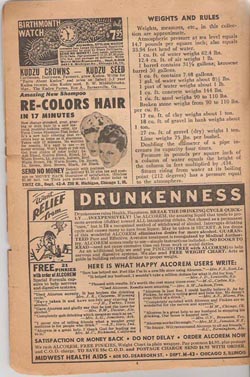
This sampling from the 1953 issue of Grier's Almanac features a half-page ad offering an "amazing liquid that tends to promote aversion (dislike) toward ALL intoxicating drinks." Also, kudzu had apparently not sufficiently invaded the South by 1953. B. W. Middlebrooks of Barnesville, Georgia, was advertising seed and kudzu crowns for sale! Quite a contrast from the previously illustrated 1934 edition, the 1953 issue featured ads from two separate publishers promoting illustrated books on the topic of sex!
BIBLIOGRAPHY
Frank Veale Jr., "Georgia's Amazing Robert Grier: They Forgot Him, But Not Almanack," Atlanta Journal, October 7, 1967.
"Grier's Almanac," New Georgia Encyclopedia. Retrieved May 15, 2006: http://www.newgeorgiaencyclopedia.org
"This Day in Georgia History: January 9: 1780," Carl Vinson Institute of Government (University of Georgia). Retrieved October 2004: http://www.cviog.uga.edu
OTHER SOURCES
Telephone conversations with Bryan Bachler, Grier's Almanac Publishing Company, Atlanta, in October 2004 and on January 19, 2005
1934 Grier's Almanac
1953 Grier's Almanac
2006 Grier's Almanac
Frank Veale Jr., "Georgia's Amazing Robert Grier: They Forgot Him, But Not Almanack," Atlanta Journal, October 7, 1967.
"Grier's Almanac," New Georgia Encyclopedia. Retrieved May 15, 2006: http://www.newgeorgiaencyclopedia.org
"This Day in Georgia History: January 9: 1780," Carl Vinson Institute of Government (University of Georgia). Retrieved October 2004: http://www.cviog.uga.edu
OTHER SOURCES
Telephone conversations with Bryan Bachler, Grier's Almanac Publishing Company, Atlanta, in October 2004 and on January 19, 2005
1934 Grier's Almanac
1953 Grier's Almanac
2006 Grier's Almanac